
How to Write Better AI Comic Prompts: A Practical Framework
A repeatable prompt framework for clearer scenes, stronger characters, readable dialogue, and more consistent AI-generated comics.
 Comic Brief Team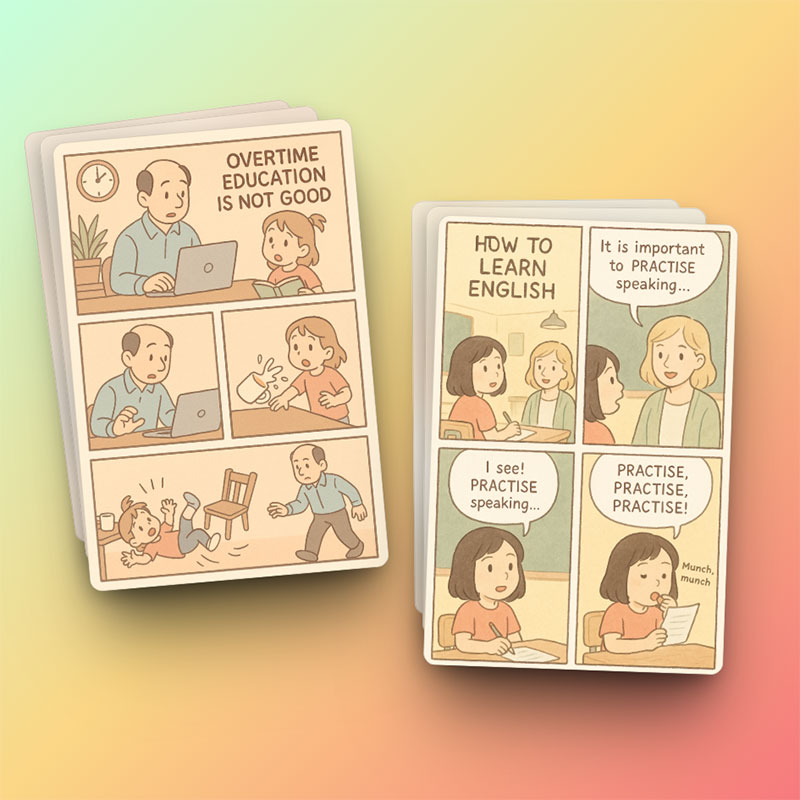
A useful comic prompt is not a pile of visual adjectives. It is a compact production brief. The model needs to know what happens, who is present, what the reader should notice, and how the final image should be organized.
Start With The Story Job
Write one sentence describing what the comic must accomplish. For example: “Explain why password reuse is risky,” “Show a founder learning from a failed launch,” or “Deliver a visual punchline about remote meetings.” This sentence keeps every later choice focused.
Use Five Building Blocks
1. Format
Choose the structure before writing scenes. A single panel works for one strong moment. Four panels work for setup, development, change, and payoff. An infographic comic works when labels, comparisons, or steps matter more than dramatic continuity.
2. Character Anchor
Describe each recurring character with a few stable traits: approximate age, hairstyle, clothing, silhouette, and one distinctive feature. Keep those traits unchanged across panels. Saved character references are even more reliable than repeating a long description.
3. Panel Actions
Give every panel one primary action. “Maya stares at three failed login alerts” is easier to render than “Maya is worried about security while remembering everything that happened.” Visible actions produce clearer compositions.
4. Camera And Mood
Use simple direction: wide establishing shot, medium conversation shot, close-up reaction, overhead diagram. Add lighting and mood only when they support the story. Too many competing style words usually weaken the result.
5. Text Constraints
Keep dialogue short and specify exact wording only when it is essential. AI-generated lettering can contain errors, so always inspect names, figures, labels, and calls to action before publishing.
A Four-Panel Prompt Template
Create a four-panel [art style] comic about [story job]. The recurring character is [stable character anchor]. Panel 1: [visible setup]. Panel 2: [complication]. Panel 3: [decision or change]. Panel 4: [payoff]. Use [camera or mood notes]. Keep dialogue under [number] words per panel. Maintain the same face, clothing, and colors throughout.
Improve One Variable At A Time
When a result is close, do not rewrite everything. Keep the story and character anchor, then change only the weakest element: framing, expression, panel pacing, color, or text. Reference images help preserve successful decisions while you refine the rest.
Final Review
Before using a comic, check character continuity, hand and object details, text accuracy, factual claims, brand marks, and whether you have permission for every reference image. A strong workflow includes review—not just generation.